Terminally Online Creatives
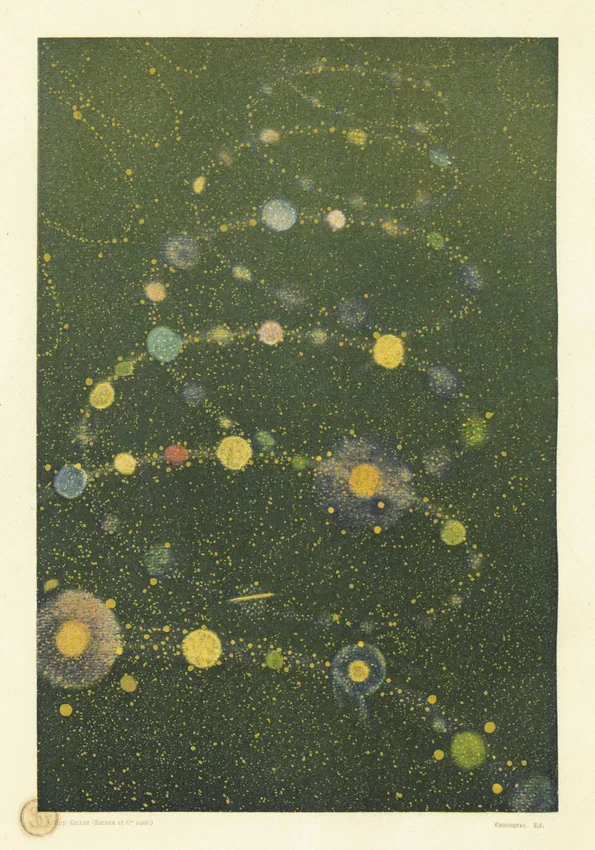
Star Cluster in Hercules Étienne Léopold Trouvelot
Can you make a living as an artist without being chronically or terminally (as we sometimes now say as if giving a dead end diagnosis) online? This is a complicated question, and something that I ask myself regularly.
I think that giving some background on the way I developed a relationship with the internet matters, because I was in both the before and after long enough to understand that it has changed the focus of some of work and the way that I work. I also know that the timeline has impacted the way I tend to negatively view our constant connectedness. If you are even just slightly older or younger than I am, it’s likely that you have a much different perspective on, and relationship to, the internet.
The internet has always been a part of my creative career. I entered college at the tail end of the AOL and dial-up era, having only started to use email and instant messenger in high school. I’m sure that email and the ability to listen to CDs from the music library in my apartment made my undergraduate degree easier.
I created a website for myself just before I finished grad school, which was a relatively new possibility for those that didn’t know how to use manual HTML coding, knowing that I would need it to serve as a business card on the web in a newly and constantly changing professional landscape. It wasn’t that common yet for musicians to have full-fledged sites showing their qualifications, teaching policies and availability, and even sound clips, so for a while having a clean, functional website set me apart. It was remarkably affordable, as new technology can be when no one has realized its value yet. Maintaining that website showed (or at least I hoped it showed) that I was young, professional, and “in touch” with the times.
Of course as time went on it became commonplace to have a website, and often a very nice one, for the purpose of securing clients, gigs, and collaborations. Social media existed, but it was still mostly for college students and the sharing of hundreds of random photos of your weekend escapades, friends, animals, and anything else you found remotely interesting. The internet was divided into two distinct camps of social and business at that point, and the simplicity was, in hindsight, refreshing.
During the time I was in college, blogging sites like Xanga became commonplace. MySpace had already gone out of vogue around 2009 or 2010, but I was never overly invested in either of those sites which felt clunky and not very rewarding for the effort required (although I absolutely wondered at the people who managed to make them look cool).
I remember distinctly how it seemed slightly insane to me the way people I knew spilled all their personal thoughts and feelings on their Xanga blogs pages as if they were a personal diary that happened to be available to everyone on the internet, openly sharing the intimate and relational details of their lives. Now the things they shared seem incredibly mild and bland compared to the thoughts, images, videos, routines, and rants that we see each day online. If you came of age with our current model of social media, you might not realize the way our tolerance for the ultra-personal has shifted with the times.
Tumblr was also popular as I entered my professional life, and it felt like a unique space that could bridge personal and professional interests. I still think longingly about the Tumblr I had where I shared small posts about all types of music that brought me joy. As I worked out writing this particular piece I went back to visit Tumblr, assuming that it no longer existed and was pleasantly surprised to find it fully intact. I was able to revisit my old posts and writing, including some early short form blogs I had forgotten about, and a blog I had kept for photos of my first cat (how wholesome). I don’t know that it lived up to my nostalgia, but it did feel like a genuine way to spend time with a previous, earnest version of myself.
I finished graduate school in what now seems like a magical era of “just enough” internet. I was searchable, but in a way that didn’t require my daily participation online. I updated my website occasionally, used email to schedule students, gigs, and professional opportunities, and used social media sparingly to keep up with my friends and post pictures of my cat and coffees (some things have not changed).
Looking back from our current “terminally online” era, I desperately miss the simplicity of those early working years. There were no reels or image carousels to style perfectly, no pressure to cultivate an aesthetic, no sense you needed to go viral to be legitimate, and absolutely zero pressure to post daily or even consistently. The most important work in my day to day life was practicing, teaching, and brainstorming, researching, and implementing future projects.
I resisted our current use of social media for a long time, but during the pandemic I felt the physical isolation as a push to search for a way to be online and share my work more in a way that felt authentic to me.
So much information that could be useful gets distilled to the point of meaningless in Instagram carousel posts, reels, and stories. This felt especially pronounced around 2020, and was a big reason I disliked the social media content that being made as a means to solicit customers or students or grow someone’s visibility. I still personally dislike making videos and being on camera, and have always enjoyed long form writing, whether I’m the reader or the writer. For all of those reasons, I chose to start writing a blog on my website during the pandemic.
Besides the short blogs on the Tumblr that I wrote between 2014 and 2016 that I mentioned earlier, I had done some blogging for local websites and for Powell Flutes when they curate a blog titled Teach Flute. I knew that writing was something I enjoyed and felt capable of. Finding topics to write about, making the time to write, and being consistent never felt like the challenges. It was how to share or promote (that word still makes me cringe) my writing that felt complicated. I suppose some of that was because I was also intending to share from the perspective of being a flutist and musician. A positive of my online journey is that I’ve loosened and grown my identity, albeit slowly and with some discomfort, to include other aspects of my creativity.
Along those lines, it is inevitable if you work in the arts or want to share your creative work online that you will be faced with the uncomfortable overlap of professional and self promotion. Perhaps because I am a private person in my “real life,” it’s taken years for me to learn how to feel comfortable with the knowledge that what I’m choosing to share online is only a portion of my story or life and that how others perceive me or my work is not something I can control.
I do believe that it is extremely difficult to build a modern network, following, or clientele without some use of the internet or social media unless you have other very large or well-known platforms that are helping to make your work visible. Even in journalism you now find full time writers for publications like The New Yorker growing their own paid subscriber blogs on Substack. That trend, in particular, feels like the biggest indicator of the instability of our times when it comes to working, or promoting your work, online. Perhaps what it indicates even more is the way work and the manner of promoting the work have become inseparable.
Up until recently, consistently sharing educational, inspirational, or musical content on social media felt crucial to a “successful” freelance career. At the very least, we find it necessary to share what we’re up to online so that our broader network sees us working. Many of us who make our living freelancing and stitching together a variety of work have also been through phases of creating educational reels, courses, or downloadable resources. And it’s not that these things don’t have value, but more that the Internet has become so crowded with these types of resources that it feels almost impossible to find the legitimate or genuinely useful ones.
It can feel daunting to consider how you might break through all the noise with whatever it is you want to share online. Perhaps if you remain consistent then you will slowly but surely grow an engaged audience for your work. But then, that depends on the algorithm and what it chooses to show people, including those who already follow you. Still, we’re told that consistency is key. No matter what, keep posting.
There is also an unspoken pressure to make money online - an underlying assumed truth that the money is out there and if you’re not getting it then you’re not engaging correctly. I want to emphasize this point: no matter what you do, we now collectively believe it should be able to generate money online.
With the rise of Substack, this sentiment has become even more pronounced. All writing, regardless of quality, can be tucked behind a paywall. Every business person, personality, and creative has something to sell. Really, Substack is just another platform in the long line of self-proclaimed easy wins for those who want to move generate revenue online, no matter the format: Patreon, Udemy, Kit, Ko-fi, etc.
The biggest difference in our approach to the internet between the early 2000s and now is the sense that the internet is the answer. Now we believe that the right posts will make you famous, rich, popular, meaningful, insert desired adjective here. Then we believed the internet was a tool - a way to share a glimpse of who you were in order to encourage the building of a deeper connection around the type of work you wanted to do.
Perhaps our experience being chronically online as creatives feels so frustrating because we’re aiming for the wrong thing. We’ve started aiming for likes and views, online revenue on each new platform that arrives. We adapt, parry, and adjust, spending hours and resources on doing that things that are adjacent to, but decidedly not, our art.
This has potential to be positive - we might learn interesting new skills and learn how to talk in new ways about our passions and skills. But it has just as much potential to draw us away from our true objectives. Time spent building online revenue is very different from the time I spend becoming a better musician. The two can coexist, but we have to be vigilant.
When did we transition our focus away from building a real network and onto building a large one? I’m sure it was around the same time we decided to invest time in learning how to be online in the most modern sense.
Instead of leaning into that elusive huge following, what if we cultivated an engaged one? Rather than an enormous email list, would we see a bigger outcome and more positive experience from engaging with a community that writes us back and participates in meaningful conversations?
I can think of so many creatives - authors, artists, musicians - who I admire and seek out who have never gone viral, who do not have large numbers of followers, but who are doing interesting work and are online in their own way.
And those folks who are so repostable online? Does that really make them more knowledgeable, creative, and helpful, or does it simply generate more trivial income and menial tasks for them?
We confuse the benefits of sharing our hard work online with the pervasive influencer culture where sharing generic products generates tremendous wealth. If you’re a creative trying to work online, it’s up to you to consider what your real work is. You don’t have a generic product to sell. You have something niche and unique to you that you want to share online, not that lives there (usually). That certainly doesn’t fit the agenda of social media, and yet we keep trying to fit the square peg into the round hole.
If you’ve been concentrated on the internet as the answer, it might be time to shift your focus. Try sharing what you do more deeply and frequently with your existing network. My newsletter took hold only because people I knew in real life subscribed. It grew from there as they generously shared with their friends they thought might be interested. It did pick up new subscribers with some consistent posting online who have since become a genuine part of my network, but it does not have a huge following by any means. It is communal and conversational, which, deep down, is what I really want it to be. Does it matter how many people it connects with if it gets to the right ones?
For those of us who are freelancing and trying to use social media as a catalyst, it’s important to keep remembering that it is a tool. What are you using it for? To build relationships? As a business card? To provide a sense of who you are to people you’re just meeting? Answering these questions can provide the clarity we need to help us decide how much time and effort we really want to spend online.
Although it can be hugely beneficial in the long run, social media remains unpaid work for many of us and it’s crucial to set a boundary around how much of that work you are will to do and how much time you are willing to sacrifice for it. Being online has led me to more work, but not proportionally to the amount of time I have spent.
I believe that we need to be online in some fashion as creatives, but I don’t buy that it has to be Instagram, TikTok, or Substack. I think having your own website and hosting what you want to share online there is just as valuable, if not more valuable, as it was in the early 2000s. The advantage of hosting your own information in our current time is ownership, and we’ll have to continue to think very carefully about where we share and what they do with our creations.
If we’re going to stay online, we owe it to ourselves to remain in control of our focus and purpose - not as easy task for anyone anymore. The internet can still be a means for building a tangible network (rather than a large one), for sharing what we want others to know about us and our work, and for engaging in conversation about our disciplines and interests.
If we are going to continue to include social media in our lives, then we need to remind ourselves often that our work and time spent there is largely unpaid (you can do the math on its benefits in your life specifically by looking at how many clients/purchases of your work and what engagement it has generated for you). We must also remember that social media is something we have to manage just like our health and wellness and engage or disengage as needed by being attentive to our own rhythms, reactions, and intuition.
I do harbor a general negative feeling about social media and the current state of the internet, even though there are things about it I love. I think it steals time from all of us, even the most disciplined. I feel nostalgic for the old Tumblr and poking around on people’s MySpace and Xanga pages and the inevitable boredom that came on quickly from doing so. I miss practice breaks where there was not accessible internet and I reset my brain by daydreaming, doodling or practice journaling, going for a walk, or just staring off into space for a few minutes. I love taking and sharing aesthetic photos, but those have nothing to do with my freelance work gigging or teaching. It’s important to acknowledge what is useful and what I just happen to enjoy, and to remember that I can always change the way I engage for work and for fun, which usually means checking out for a while.